Lëtzebuergesch has (or used to have) 2 similar but distinct sibilants post-alveolar /ʃ/ and palatal /ç/, but those sounds are now well on the way to merging into a single alveolopalatal sound /ɕ/. A recent paper examined the nature and spread of this change (Conrad, 2023).
The paper concludes that:
- this change is almost complete among younger speakers.
- among older men, the change is more advanced in the south of Luxembourg—probably because many older men in the south used to work with native speakers of French or Italian. Both those languages lack a separate sound /ç/.
- among older women, the change is progressing at the same pace in both the south and elsewhere.
In this post, I summarise:
- the source of palatal /ç/
- the source of post-alveolar palatal /ʃ/
- the merger of /ç/ and /ʃ/
- explaining the merger
- corresponding voiced sounds
- Conrad’s tests
- Conrad’s findings
Lëtzebuergesch (Luxembourgish) was officially designated as the national language of Luxemburg in 1984. It is a Germanic language descending from a Moselle-Franconian dialect of German. Lëtzebuergesch Archives – Language Miscellany
Source of palatal /ç/
In both Lëtzebuergesch and its close relative German, the post-alveolar sound /ʃ/ and palatal sound /ç/ have different historical sources. /ç/ was regarded not as a separate phoneme but as an allophone of the velar fricative /χ/:
- the allophone [χ] appears after back vowels (eg /u/, /o/). In German, it is known as the Ach-Laut (final consonant of the German word Ach).
- the allophone [ç] appears after front vowels (eg /i/, /e). In German, this allophone is known as the Ich-Laut (final consonant of German word ich).
(In German, [ç] also appears after sonorants /n l r/ and the diminutive suffix –chen. I don’t know whether that is also true for Lëtzebuergesch.)
Source of post-alveolar palatal /ʃ/
The sound /ʃ/ came from a different source. In German, it often came from the consonant cluster /sk/, or from other sequences of /s/ and another consonant.
I haven’t yet found a clear description of all sources of /ʃ/ in German and Lëtzebuergesch.
Merger of /ç/ and /ʃ/
In Lëtzebuergesch and in some German dialects, /ç/ and /ʃ/ have now merged, or are merging, in a process that seems to have begun in the mid 19th century.
Conrad summarises and refers to Hall (2013), which analyses the merger between the sounds. Diagram 1 (taken from Hall) summarises 4 stages in how these sounds developed in some dialects of German (including standard German) and in Lëtzebuergesch.

In stage 1, the phoneme /x/ is pronounced [x] even after front vowels. Middle High German (MHG, spoken around 1100-1300) was in this stage. Alemannic and Bavarian dialects (spoken in Switzerland, Austria and Bavaria) are still in this stage.
In stage 2, the velar fricative /x/ is now pronounced [ç] after front vowels, as well as after the three sonorant consonants /n l r/ and in the diminutive suffix –chen. Early modern standard German (NHG) entered this stage (perhaps around the mid 18th century) and standard German is still in stage 2.
In stage 3, the sound that was /ç/ in stage 2 becomes pronounced as /ɕ/. There is not yet any change in the pronunciation of /ʃ/. Cologne German is in this stage.
In stage 4, /ʃ/ and /ɕ/ merged, and both are pronounced as /ɕ/. German spoken in Leipzig and Speyer is in stage 4, and so is Lëtzebuergesch.
I’ve written before about the alveolopalatal sound /ɕ/ in:
- Swedish https://languagemiscellany.com/2023/08/is-that-swedish-sj-sound-really-a-sibilant/
- Mandarin https://languagemiscellany.com/2022/01/mandarin-sibilants/
Explaining the merger
Hall argues that:
- /ç/ contains the features [CORONAL, DORSAL]
- /ʃ/ contains the features [CORONAL, LABIAL]
- /ɕ/ contains the feature [CORONAL], but not [DORSAL] and not [LABIAL]. Hall analyses the changes described above as simplification: deleting the feature [DORSAL] from /ç/ and the feature [LABIAL] from /ʃ/, turning both sounds into /ɕ/.
A sound with the feature [CORONAL] involves raising the front of the tongue. A sound produced with the body of the tongue raised has the feature [DORSAL]. A sound involving the lips has the feature [LABIAL].
Deleting [LABIAL] from vowels
There is some independent support for Hall’s idea that the transition from /ʃ/ to /ɕ/ involves deleting the feature [LABIAL].
- as Hall says, in varieties of German that have changed /ʃ/ to /ɕ/, a similar loss of the feature [LABIAL] also occurred to front rounded vowels (with both [LABIAL] and [CORONAL] features, such as /y/—written in German as <ü>). They lost the feature [LABIAL], becoming the corresponding front unrounded vowels ([CORONAL], such as /i/).
Conversely, Cologne German has retained the feature [LABIAL] in both /ʃ/ and front rounded vowels. - unlike [ɕ], [ʃ] involves rounded, protruded lips. Conrad (2023) calls this fact the most striking and noticeable difference between [ʃ] and [ɕ]
- as Newton (1993) says (reported in Hall), many speakers of Lëtzebuergesch have extreme difficulty in acquiring the German Ich-Laut /ç/. They substitute instead an allophone similar to the palato-alveolar voiceless fricative /ʃ/, produced without the labialization occurring in modern standard German.
Corresponding voiced sounds
The sounds /ç ɕ ʃ / discussed above are all unvoiced. Both Hall and Conrad also discuss parallel changes involving the corresponding voiced sounds /ʝ ɣ ʒ /.
Conrad’s tests
It appears that in Lëtzebuergesch the allophone [ç] is now merging with the separate phoneme /ʃ/, with both now being increasingly pronounced as /ɕ/. Conrad (2023) tests where and how this merger is proceeding in Luxembourg.
Conrad’s 1st test locked at 5 contrasting pairs of words (table 1).
| Words with /ç/ | Words with /ʃ/ |
| frech /fʁæç/’mean, cheeky’ | Fräsch /fʁæʃ/ ‘frog’ |
| mécht /məçt/ (he, she) ‘does’ | Mëscht /məʃt/ ‘manure’ |
| Flächen /flæçən/ ‘surfaces’ | Fläschen /flæʃən/ ‘bottles’ |
| dech /dəç/ ‘you ACC’ | Dësch /dəʃ/ table |
| fiicht /fiːçt/ ‘humid’ | viischt /fiːχtən / ‘front’ |
This test involved 48 people drawn from 3 generations:
- for 2 of the pairs of words, participants heard German sentences read by a native speaker of German and translated the sentences orally into Lëtzebuergesch. Those 4 German words (frech, Frosch, macht, Mist) are all obvious cognates of their Lëtzebuergesch counterparts.
- participants read aloud Lëtzebuergesch sentences containing the other 6 words.
Conrad’s 2nd test was an exploratory study of 3 individuals (of different generations) from a family in the north of Luxembourg and 3 individuals from a family in the east different.
Conrad’s findings
Conrad reports that:
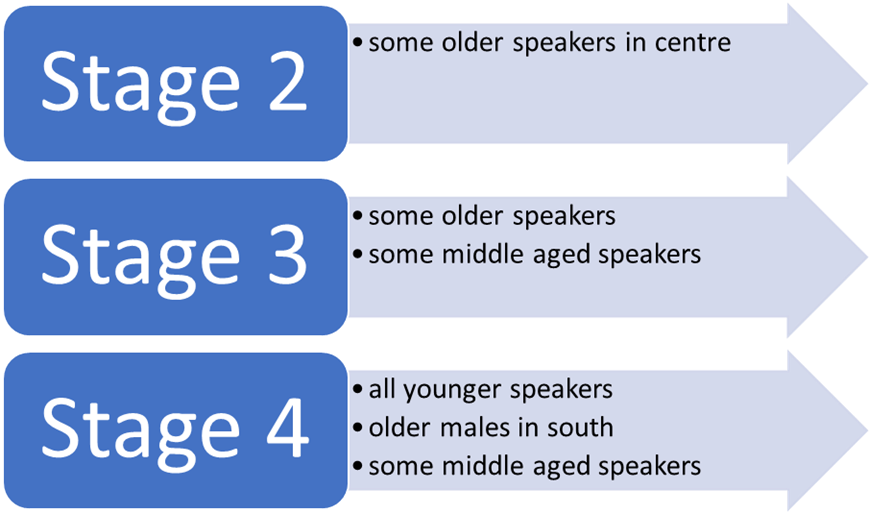
- the merger between the 2 sounds /ç/ and /ʃ/ is complete amount younger speakers.
- among older men, the merger is more advanced in the south than in the centre. But among older women, the merger is equally advanced in the south and in the centre.
Diagram 1 shows those results, analysed by Hall’s stages 2-4
Influence from French and Italian?
Many other sociophonetic and sociolinguistic studies have shown women leading sound changes. Conrad suggests a reason why men are leading this change in the south (a former mining region): many older men there worked in the past with many native French speakers from France and Belgium and with many native Italian speakers. Those older men were exposed at work to influence from French and Italian, which do not have the consonant [ç].
An unexplained new change in younger speakers?
Conrad did find some instances of younger speakers making a new (though small) distinction between the 2 sounds (a distinction not made by older speakers). He doesn’t attempt to explain this finding.
Source
Regional differences in the evolution of the merger of /ʃ/ and /ç/ in Luxembourgish, François Conrad, Journal of the International Phonetic Association, Volume 53, Issue 1 (April 2023)
Alveolopalatalization in central Germany as markedness reduction, Tracy A Hall, 2013, Transactions of the Philological Society 112(2), 1–24. Allophonic variation in Luxemburgish palatal and alveolar-palatal fricatives: discussion of an areal survey taken in 1979, Gerald Newton, in Das Unsichtbare Band der Sprache. German Language and Language History Studies in Memory of Leslie Seiffert, edited by John L Flood, Paul Salmon, Olive Sayce, Christopher Wells (1993)
Luxembourgish Peter Gilles, Jürgen Trouvain, Luxembourgish | Journal of the International Phonetic Association Volume 53, Issue 1 (2023)